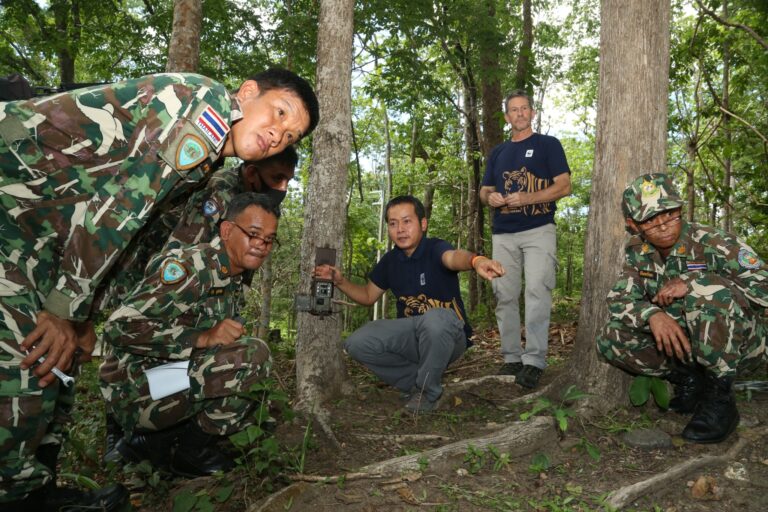
Research on the distribution, abundance, and ecology of tigers and prey populations is an important aspect of tiger conservation. We are working on tiger and prey monitoring as part of the Tiger Recovery Program to create a long-term tiger population database. This information on tiger population dynamics will be useful for wildlife management and protection.
The tiger population database in the area has been linked to nearby areas to provide a landscape-scale overview of tiger populations and their distribution. The tiger database also contributes to Thailand’s tiger database, which is managed by the DNP, in order to keep the country’s tiger population up-to-date. This research data helps to inform conservation efforts and indicates whether tiger conservation is successful.
Mae Wong Forest: A Haven for Banteng Recovery
The banteng (Bos javanicus): is a large bovid classified as an Endangered Species on the IUCN Red List. Their population is continuously under threat due to heavy poaching and habitat destruction and it’s known that the global population is now less than 8,000. Approximately 2,300-2,500 bantengs were found in Thailand in 1970, but by 1995, only 500 were recorded, representing a decline of more than 80 percent.
Mae Wong National Park provides a healthy natural habitat for bantengs, which prefer lowland and deciduous forests but sadly, the banteng became extinct in Mae Wong forest due to heavy poaching. However, some bantengs were photographed from the most recent survey conducted by Mae Wong National Park and WWF Thailand, providing concrete evidence that bantengs have returned to the forest. Bantengs found here are a breeding population that most likely dispersed from Huai Kha Khaeng Wildlife Sanctuary after being absent for more than 40 years. Interestingly, because the banteng is one of the tiger’s favourite prey, its recovery will, in turn, benefit tiger conservation efforts in Mae Wong as well.
The return of the banteng to Mae Wong forest is exciting news which reflects the success of this area’s efforts to recover the population of large ungulates and globally endangered species. Thanks to the rangers’ intensive protection efforts, ecosystem restoration, and cross-sector collaboration, the bantengs are finally able to return to their natural habitat.
The Tiger Recovery Project has been working on banteng in Thailand since 2015, when we partnered with other institutions to reintroduce captive banteng into Salakpra Wildlife Sanctuary. Since then we have been monitoring the recolonization of banteng into Mae Wong National Park. On May 16, 2023, we organized the first national workshop on banteng status and conservation, which resulted in a comprehensive update of the distribution, abundance, and population trends of banteng in Thailand (both captive and wild). This information is in our newly-launched book, and was presented at the banteng event on March 26, 2024.